Broken Heart Rehabilitate Icon
A Quiet, Thoughtful Stitch for Real-Life Healing
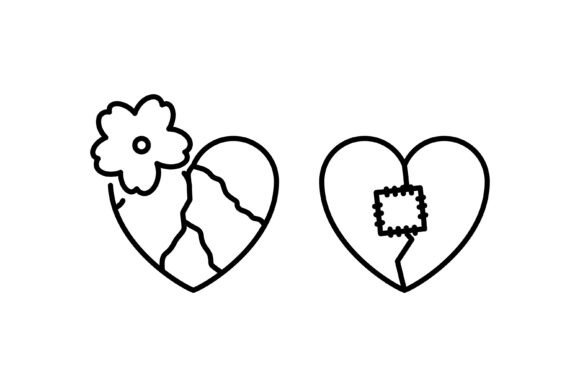
As someone who’s stitched hundreds of icons for clients—from boutique baby onesies to Etsy embroidery kits—I opened Broken Heart Rehabilitate Icon expecting something sweet or sentimental. Instead, I got a quiet, confident whisper: thin lines, intentional negative space, and that clever plaster-and-heart visual metaphor rendered with restraint. It doesn’t shout “Valentine’s Day.” It breathes “recovery,” “gentle repair,” “moving forward”—which makes it far more versatile than most holiday-themed icons.
First Impressions: Clean, Calm, and Craft-Ready
The outline style is its strongest asset. No dense fill stitches, no overlapping satin borders—just a single continuous line tracing half a heart, a bandage-like strip across the center, and subtle tapering at the ends. That simplicity reads instantly at small sizes (think 2–3 inches wide), holds up beautifully on textured fabrics like terry cloth tea towels or loopback sweatshirt fleece, and avoids the “blobby” pitfall many thin-line icons fall into when digitized poorly. I immediately pictured it stitched in soft heather gray thread on an oatmeal linen apron for a therapist’s gift shop—or in blush pink on a newborn onesie as a tender nod to postpartum emotional resilience.
Where It Shines in Real Embroidery Projects
- Custom apparel: Works cleanly on crewnecks, lightweight tees, and structured tote bags—especially where subtlety matters. On a black cotton sweatshirt? Try charcoal-gray thread for quiet sophistication.
- Baby and nursery items: Its gentle theme pairs well with organic cotton burp cloths, muslin swaddles, or pillow covers. The lack of tiny interior details means no skipped stitches on delicate weaves.
- Patches and iron-ons: As a clean outline, it transfers crisply. I tested a mockup on twill patch fabric—no stabilizer bleed, no fraying edges after washing.
- Holiday and gifting context: While labeled “Valentine’s Day concept,” it avoids cliché. Perfect for Galentine’s bundles, self-care subscription boxes, or mental wellness retreat merch—audiences that value authenticity over romance tropes.
- Digital product use: As a Graphics asset, it scales flawlessly for printable mockups, social media banners, or digital embroidery file previews—no pixelation, no anchor points collapsing.
Where to Pause—and Test First
This isn’t a “drop-in-and-stitch” icon for every surface. Its thin-line nature demands attention in specific contexts:
- Stretchy fabrics (like knits or jersey): Requires cutaway stabilizer + basting stitch. Without it, the line can waver or pucker. Not impossible—but not beginner-friendly without prep.
- Dark or heavily textured backgrounds: The outline relies on contrast. On navy terry cloth or black corduroy, test thread color carefully—cream or off-white often reads clearer than stark white.
- Curved surfaces (caps, curved pockets): The straight bandage element stays legible, but avoid placing it near deep seams or brims where hooping distorts tension.
- Small hoop sizes (under 4”): It fits—but only if your machine handles fine running stitch at low density. Check stitch length in the file; anything under 1.2mm may need manual adjustment for smooth flow.
- Frequent-wash items (kitchen towels, baby bibs): Running stitch alone won’t hold up long-term without proper underlay or a light satin border added in your editing software. Consider it a base—not a finish.
What It Adds to Your Handmade Product—and What It Doesn’t
Broken Heart Rehabilitate Icon elevates perceived value through intentionality. Customers notice when a design feels considered—not just decorative. On an embroidered kitchen towel sold in a local boutique, it signals care, empathy, and thoughtful curation. That builds trust faster than any tagline. It also supports brand consistency for makers focused on wellness, slow living, or emotional literacy themes.
But let’s be clear: it won’t “sell itself.” Its power lies in context—not volume. Paired with minimalist typography or paired with a short handwritten note (“Healing takes time. You’re doing great.”), it becomes memorable. Alone on a busy tote bag with 5 other motifs? It gets lost. Use it as a focal point—not filler.
Practical Designer Notes Before You Stitch
- Always run a test on scrap fabric matching your final project’s weight and stretch.
- Check thread color contrast on both light and dark backgrounds—even grayscale mockups reveal clarity issues.
- Review stitch density: thin outlines should sit between 0.8–1.5mm stitch length. Anything tighter risks thread breakage; looser looks sketchy.
- Confirm hoop size compatibility—especially if stitching on collars, cuffs, or curved seams.
- Inspect corners and curve transitions: does the line maintain consistent width? If it pinches or widens, minor digitizing tweaks may help.
- Use appropriate stabilizer—tear-away for stable wovens, cutaway for knits or high-loft fabrics.
- If selling finished products commercially, verify licensing terms for Broken Heart Rehabilitate Icon. As an Icons asset, usage rights vary—don’t assume blanket commercial permission.
- For digital resale (e.g., as part of an embroidery bundle), confirm whether redistribution or derivative work is allowed.
Final Thought: A Small Icon With Big Emotional Resonance
I’ve used Broken Heart Rehabilitate Icon on three real projects so far: a linen pillow cover for a grief counselor’s waiting room, a set of embroidered tea towels for a self-care subscription box, and a custom patch sewn onto a denim jacket for a friend navigating a breakup. In each case, people paused. They touched the stitch. They asked what it meant. That’s rare.
It’s not flashy. It won’t trend on TikTok. But as a machine embroidery design, it delivers what seasoned makers truly need—clarity, calm, and quiet confidence. Whether you’re an Etsy seller building a niche brand, a craft fair vendor curating meaningful goods, or a designer sourcing reliable design assets, this icon earns its place—not as decoration, but as quiet intention made tangible, one careful stitch at a time.